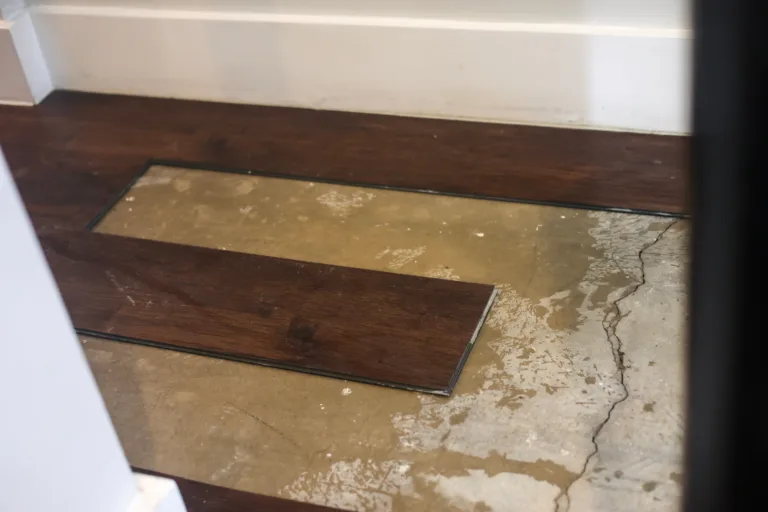
Most water damage doesn’t announce itself. There’s no bang, no flood, no dramatic moment where you know something’s wrong. There’s a pinhole in a copper line behind drywall, or a supply hose under the kitchen sink that’s been weeping for six weeks, and by the time you notice the warped baseboard, the repair bill has already tripled.
We see it constantly across Mesa, Gilbert, Chandler and the rest of the Valley. And here’s what stings: almost every one of those calls was preventable, not by being a more attentive homeowner, but by having something watching the water line when nobody’s home.
That’s what whole-home leak detection does. Below, we’ll walk through why Arizona homes are especially vulnerable, the warning signs worth knowing, and how a smart water monitor like the Flo Smart Water Monitor and Shutoff by Moen actually works.
Why Leaks Hit Arizona Homes Harder
Three things stack the deck against Phoenix Valley homeowners.
Our water is punishing. Phoenix-area water commonly tests between 13 and 17 grains per gallon, squarely in “very hard” territory. Those dissolved minerals don’t just leave spots on your shower door. They scale the inside of your pipes, cut the working life of a water heater short, and grind away at valve seats and supply connections year after year. Hard water is a slow, constant tax on every fitting in your house.
Most of us are built on slab. Valley homes typically sit on concrete slabs with water lines running underneath. When one of those lines fails, the water has nowhere to go but sideways and up, through the slab, into flooring, into framing. A slab leak can run for weeks before anyone spots a warm patch on the tile or hears water moving with every tap turned off. By then it’s a jackhammer job, not a repair. We get calls like this far too often which is why our team is consistently educating customers on the importance of whole-home leak detection shut-off systems. A small upfront investment can save you thousands in repairs later on down the line.
Half the neighborhood is empty half the year. Snowbird homes, rentals between tenants, second properties sitting quiet from May to October. A supply line that fails in an occupied house is a bad afternoon. The same failure in an empty house is a catastrophe measured in months. With such advanced technology available, it seems silly to not adapt to smart-home upgrades that can save you from literal disaster happening in your home when you aren’t around.
Add it up and you get a real number: roughly 1 in 15 insured homes files a non-weather water damage claim in a typical five-year policy period, and water damage and freezing claims averaged $13,954 over a recent five-year stretch. That’s not a rare event. That’s a coin flip you keep making every year.
Signs You May Have a Hidden Leak
Before we get to technology, know what to watch for. Call a Hansen Family Air Conditioning & Plumbing if you notice:
- A water bill that climbed without explanation. Same habits, same season, higher bill. This is the single most common tell.
- The meter moves when nothing is running. Shut off every fixture, then check your meter’s low-flow indicator. If it’s spinning, water is going somewhere.
- Warm or hot spots on the floor. Classic slab leak sign — a hot water line failing under the concrete.
- The sound of running water with everything off. Especially noticeable at night.
- Musty smell, or a spot that never quite dries. Under sinks, along baseboards, in a closet backing onto a wet wall.
- Cracking or lifting flooring. Tile that sounds hollow, wood that’s cupping, carpet that’s damp in one corner.
- Water pressure that’s dropped off. A meaningful loss of pressure can point to a failure upstream.
- New cracks in drywall or stucco. Persistent moisture moves a foundation.
Here’s the catch: every one of those signs is lagging. By the time you can see, hear, or smell a leak, it’s been running a while. That’s the gap whole-home leak detection closes.
What Whole-Home Leak Detection Actually Is
Puck-style leak sensors, the little discs you drop behind a toilet or under the water heater, are useful, and we recommend them. But they’re reactive and they’re local. They tell you water has already reached the floor, and only in the one spot where you happened to put one.
Whole-home leak detection works differently. A single device installs in line with your main water supply, so every drop entering your house passes through it. It doesn’t wait for water to reach the floor. It watches the behavior of the water itself, and when that behavior stops making sense, it shuts the water off. Pretty cool, right?
How the Flo Smart Water Monitor and Shutoff Works
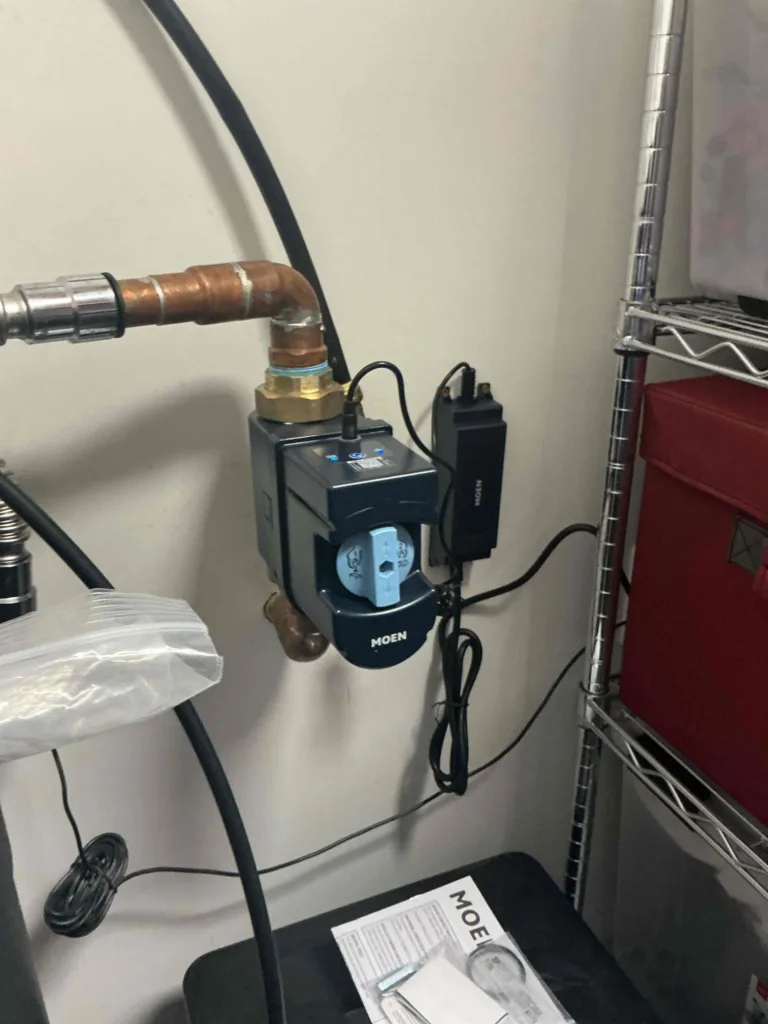
The Flo device by Moen is the system we point most homeowners toward. Here’s what’s happening inside it.
It monitors flow, pressure and temperature continuously. Every shower, every irrigation cycle, every toilet flush. It knows your home’s normal rhythm and day-to-day water usage.
It runs a daily MicroLeak test. Once a day, the valve briefly closes and measures whether pressure holds. If pressure drops with nothing running, water is escaping somewhere, and this test catches leaks as small as a drop per minute. That’s the pinhole in the wall, months before it shows up as a stain.
FloSense learns your household. The system builds a picture of your normal usage patterns, so it can flag genuine abnormalities, a line running far longer than any fixture should, instead of nagging you every time someone takes a long shower.
It shuts the water off automatically. This is the part that matters. When the system detects a failure event, it closes the valve on its own. It doesn’t need you to be home, awake, or holding your phone. A burst supply line at 3 a.m. becomes a notification instead of a restoration project.
You get alerts and remote control. App notifications, plus phone and email alerts. You can also check usage and pressure, and turn your water on or off from anywhere, genuinely useful if you’re in Minnesota in July and want to close the valve on your Gilbert house.
The Moen Smart Water app is free, no subscription required for core monitoring and control. An optional FloProtect plan adds an extended warranty and insurance deductible coverage, and some carriers offer premium discounts for homes with an automatic shutoff installed. Worth a call to your agent.
The Benefits, Plainly
- Damage prevented, not just detected. Automatic shutoff is the difference between a $200 repair and a $15,000 remediation.
- Coverage when the house is empty. Vacation, travel season, a rental between tenants, the valve doesn’t take time off.
- Lower water bills. EPA figures put average household leaks at more than 9,300 gallons wasted per year, and fixing easily corrected leaks saves homeowners about 10% on water bills. In a state where every gallon counts, that’s worth something beyond the money.
- Early warning on slab leaks. MicroLeak testing surfaces the slow underground failures that hide the longest and cost the most.
- Visibility into your own plumbing. Pressure trending high or low, usage creeping up, you see problems developing instead of discovering them.
- Possible insurance savings. Ask your carrier; many recognize automatic shutoff devices.
What Installation Looks Like
The unit installs on your main cold water line, for most Valley homes, that’s in the garage or on an exterior wall, and needs a standard outlet within about 10 feet plus Wi-Fi. It comes in ¾”, 1″ and 1¼” sizes to match your service line.
This is a professional install. It means cutting into your main, so it’s a licensed plumber’s job, both for code and for the warranty. For a typical home, it’s a same-day appointment. Our tech sizes the valve, installs it, gets it on your Wi-Fi, and walks you through the app before leaving.
Protect Your Home Before the Leak Finds It
You can’t watch your water line 24 hours a day but a smart shutoff can.
Hansen Family Air Conditioning and Plumbing has been serving Mesa and the greater Phoenix Valley since 2013, family-owned, veteran-owned, and built on one rule: we treat every customer the way we’d treat our own grandmother. If you’ve noticed a jump in your water bill, you’re heading out of town for the season, or you’d just rather not find out the hard way, we’re glad to take a look.
Call (602) 805-4836 or schedule online. We’re available seven days a week, and we’ll give you a straight answer about whether whole-home leak detection makes sense for your house.