Quick Answer: If your AC is blowing warm air, the most common causes are a dirty air filter, incorrect thermostat settings, a tripped breaker to the outdoor unit, low refrigerant, dirty condenser coils, frozen evaporator coils, or a failing compressor. Start by checking your filter and thermostat, if those look fine, it’s time to call a licensed HVAC professional.
It’s 110°F in Phoenix and your AC just started blowing warm air. Few things are more miserable, or more urgent. Before you panic, know that many of the most common causes have straightforward fixes, and some you can even handle yourself.
Below, we’ll walk through the seven most frequent reasons your air conditioner is blowing warm air instead of cold, explain what you can check on your own, and help you recognize when it’s time to bring in a pro. If you’re in the Greater Phoenix area and need help fast, Hansen Family Air Conditioning and Plumbing offers same-day AC repair service across the Valley.
How Your AC Actually Cools Your Home
Understanding the basics will help the rest of this post make sense. Your air conditioner doesn’t create cold air—it removes heat from the air inside your home and sends it outside. It does this using a closed loop of refrigerant that cycles between your indoor unit (the evaporator) and your outdoor unit (the condenser). A fan pulls warm indoor air over the cold evaporator coil, where refrigerant absorbs the heat. The refrigerant then travels to the outdoor unit, releases the heat, and the cycle starts over.
When any part of that cycle breaks down—whether it’s the airflow, the refrigerant, or one of the mechanical components—you end up with warm air blowing through your vents.
1. Dirty or Clogged Air Filter
Why It Happens
This is the single most common reason an AC blows warm air, and thankfully it’s the easiest to fix. Your air filter catches dust, pet hair, and debris before they reach the evaporator coil. Over time, the filter gets packed with buildup and restricts airflow. When the system can’t pull enough air across the coil, it can’t cool effectively. In severe cases, reduced airflow can even cause the evaporator coil to freeze over, compounding the problem.
What to Do
Pull out your filter and hold it up to the light. If you can’t see through it, replace it. In the Greater Phoenix area, where dust is a constant challenge, we recommend replacing your filter every 30 to 60 days during the cooling season. This one step alone prevents a surprising number of AC problems.
DIY or Pro?
This is a DIY fix. Replacement filters are available at any hardware store. Just make sure you buy the correct size for your system.
2. Thermostat Set Incorrectly
Why It Happens
It sounds almost too simple, but incorrect thermostat settings account for a significant number of “warm air” service calls. The thermostat may have been bumped to “heat” mode, the fan could be set to “ON” instead of “AUTO” (which means it runs continuously even when the system isn’t actively cooling), or the target temperature may have been accidentally changed. If you have a programmable or smart thermostat, a schedule change or software update could also be the culprit.
What to Do
Verify your thermostat is set to “Cool” mode. Check that the fan is set to “AUTO,” not “ON.” Make sure the target temperature is set below the current indoor temperature. If you have a programmable thermostat, review the schedule to make sure nothing was changed unintentionally.
DIY or Pro?
DIY fix. If your thermostat is unresponsive or displaying errors, try replacing the batteries first. If problems persist, the thermostat itself may need to be replaced, a quick job for a technician.
3. Tripped Circuit Breaker on the Outdoor Unit
Why It Happens
Your AC system has two main components: the indoor air handler and the outdoor condenser unit. Each typically has its own circuit breaker. If the outdoor unit’s breaker trips, the indoor fan will keep blowing air through your vents—but that air won’t be cooled because the condenser isn’t running. The result feels exactly like “warm air from the AC.” Breakers can trip due to power surges, aging electrical components, or the system drawing too much power during extreme Phoenix heat.
What to Do
Check your electrical panel for a tripped breaker. If you find one, flip it fully to the “OFF” position, wait about five minutes, then flip it back to “ON.” If the breaker trips again immediately or repeatedly, stop resetting it, that’s a sign of an electrical problem that needs professional attention.
DIY or Pro?
A single reset is a safe DIY step. Repeated tripping means call a pro, there could be a wiring issue or a failing component like a capacitor or compressor.
4. Dirty Condenser Coils (Outdoor Unit)
Why It Happens
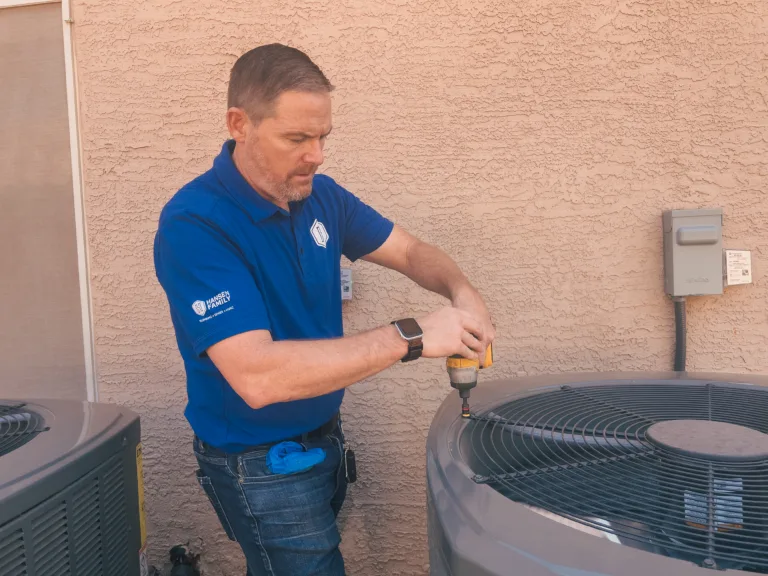
The outdoor condenser unit is where your system dumps the heat it absorbed from inside your home. If the condenser coils are coated in dust, dirt, pollen, or debris—which happens quickly in the Phoenix metro area, they can’t release heat efficiently. The system works harder and harder, cooling performance drops, and eventually the air from your vents goes from cool to lukewarm to warm.
What to Do
Go outside and take a look at your condenser unit. Clear away any leaves, branches, or debris within two feet of the unit. If the coils are visibly dirty, you can gently rinse them with a garden hose (not a pressure washer, which can damage the fins). Make sure nothing is obstructing airflow around the unit, no storage items, plants growing too close, or fencing that’s too tight.
DIY or Pro?
Light cleaning is DIY. If the coils are heavily soiled or bent, a professional coil cleaning during an AC tune-up is the safer route.
5. Low Refrigerant or a Refrigerant Leak
Why It Happens
Refrigerant is the substance that absorbs and transfers heat in your AC system. Your system doesn’t “use up” refrigerant like fuel, if levels are low, it means there’s a leak somewhere. Low refrigerant means the evaporator coil can’t absorb enough heat from the air, so the air coming out of your vents gets progressively warmer. Other telltale signs include ice forming on the refrigerant lines, a hissing or bubbling sound near the indoor unit, or your system running constantly without reaching the set temperature.
What to Do
This is not a DIY repair. Refrigerant handling requires EPA certification and specialized equipment. A licensed HVAC technician will locate the leak, repair it, and recharge your system with the correct type and amount of refrigerant.
DIY or Pro?
Always a pro. If you suspect a refrigerant leak, call Hansen Family Air Conditioning and Plumbing to schedule a diagnostic. Ignoring it will only make the problem worse and can damage the compressor.
6. Frozen Evaporator Coils
Why It Happens
When moisture in the air condenses on the evaporator coil, it’s normal. But if airflow is restricted (dirty filter, blocked vents) or refrigerant is low, the coil temperature drops too far and that moisture freezes. A layer of ice on the coil insulates it from the air passing over it, which means the coil can no longer absorb heat. Your system blows air, but it doesn’t cool.
What to Do
If you see ice on the indoor unit or refrigerant lines, turn the system off and let it thaw completely, this can take several hours. While it thaws, check and replace the air filter. Once everything is thawed and the filter is fresh, turn the system back on. If it freezes again, the underlying cause is likely a refrigerant leak or a mechanical issue that requires professional service.
DIY or Pro?
You can thaw the coils yourself, but if the problem recurs, you need a technician to diagnose the root cause.
7. Failing Compressor
Why It Happens
The compressor is the heart of your AC system. It pressurizes and circulates the refrigerant between the indoor and outdoor units. When a compressor starts to fail, it can’t maintain the pressure needed to move refrigerant effectively, which means the evaporator coil can’t absorb heat and your vents blow warm air. Warning signs include unusual noises from the outdoor unit, chattering, clicking, or grinding, the system cycling on and off rapidly (short cycling), or the outdoor unit vibrating excessively.
What to Do
A compressor issue requires immediate professional attention. Compressor failures can sometimes be repaired, but in many cases, especially on older units, replacement of the outdoor unit or the entire system is the more cost-effective choice. A qualified technician can help you weigh the options based on the age and condition of your system.
DIY or Pro?
Always a pro. Do not attempt to diagnose or repair compressor issues yourself.
Quick Reference: Can I Fix It Myself?
| Cause | DIY or Pro? | Urgency |
| Dirty Air Filter | DIY | Low – Easy fix |
| Thermostat Settings | DIY | Low – Easy fix |
| Tripped Breaker | DIY (once) | Medium |
| Dirty Condenser Coils | DIY / Pro | Medium |
| Low Refrigerant / Leak | Pro Only | High |
| Frozen Evaporator Coils | DIY + Pro | High |
| Failing Compressor | Pro Only | High – Urgent |
When to Call a Professional
Some AC issues are quick fixes you can handle in minutes. Others can cause serious damage to your system if left unaddressed. Here’s a good rule of thumb: if you’ve checked the filter, verified your thermostat, and reset the breaker, and the problem hasn’t improved, it’s time to call a licensed HVAC technician.
You should also call a professional right away if you notice refrigerant lines covered in ice, a hissing or bubbling sound coming from the unit, the outdoor unit making grinding or banging noises, your breaker trips repeatedly after being reset, or your system runs nonstop without reaching the set temperature.
Continuing to run a system with these symptoms can cause further damage and lead to much more expensive repairs down the line.
Why Phoenix Homes Face These Problems More Often
Living in the Greater Phoenix area puts unique stress on your air conditioning system. Summer temperatures regularly exceed 110°F, which means your AC runs for longer stretches at higher intensity than systems in milder climates. The fine desert dust and sand common across the Valley clog filters faster and coat condenser coils more quickly. And because many Phoenix homes run their AC from April through October, sometimes nearly year-round, components like compressors and capacitors wear out sooner.
That’s why regular preventative maintenance is especially important in our climate. An annual AC tune-up before the cooling season can catch small problems before they become big ones, extend the lifespan of your system, and keep your energy bills in check.
Frequently Asked Questions
Why is my AC running but not cooling my house?
The most common reasons are a dirty air filter restricting airflow, incorrect thermostat settings, or a tripped breaker to the outdoor unit. If those check out fine, it may be a refrigerant leak, dirty coils, or a failing compressor, all of which require professional service.
Can I fix my AC blowing warm air myself?
Some causes have easy DIY fixes: replacing a dirty filter, adjusting thermostat settings, or clearing debris from the outdoor unit. However, issues involving refrigerant, electrical components, or the compressor should always be handled by a licensed HVAC technician.
How often should I change my AC filter in Phoenix?
In the Greater Phoenix area, we recommend changing your AC filter every 30 to 60 days during the cooling season. Homes with pets, allergies, or near construction may need even more frequent changes.
Should I turn off my AC if it’s blowing warm air?
If you’ve checked the filter and thermostat and the problem persists, it’s a good idea to turn the system off to prevent potential damage—especially if you notice ice on the unit or hear unusual noises. Then call a professional for diagnosis.
Keep Your Cool This Summer
If your AC is blowing warm air and you’ve ruled out the simple fixes, don’t wait for it to get worse. Hansen Family Air Conditioning and Plumbing provides expert AC repair and maintenance across the Greater Phoenix area, including Scottsdale, Mesa, Chandler, Gilbert, Tempe, and Glendale. Our licensed technicians can diagnose the issue quickly and get your home comfortable again, often the same day.
Schedule your AC repair or annual tune-up today. Call Hansen Family Air Conditioning and Plumbing or book online.